

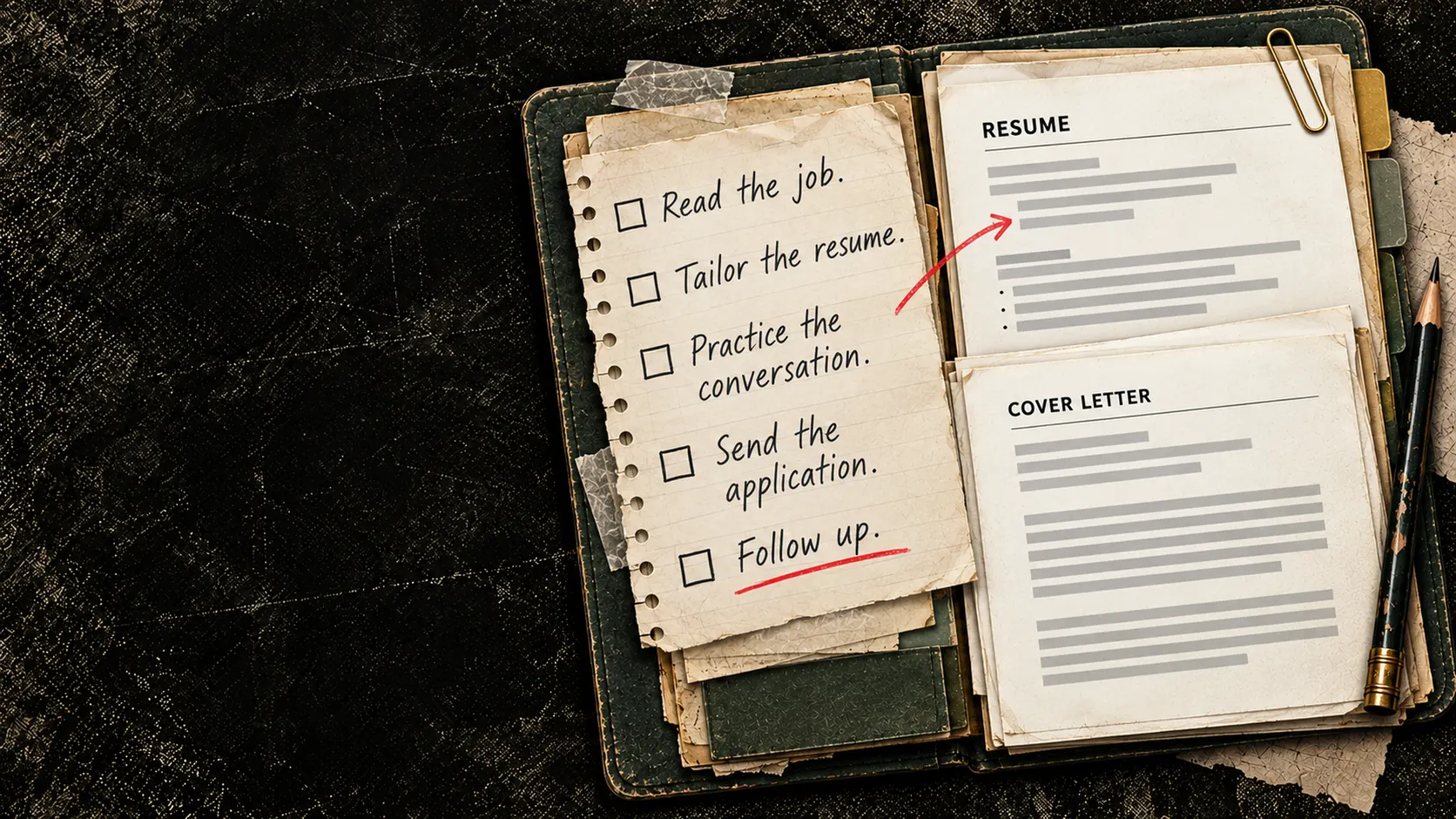
You don't need a four-year degree to build a career. You need a way in, and a record doesn't have to close every door.
You've heard the pitch before: learn a trade, skip the student debt, make good money with your hands. Then you start searching "apprenticeships for felons" and the doubt creeps in. Will a union even talk to me with a record? Do I need to hide it on the application? Is this one of those things people say is "second-chance friendly" until you actually show up?
I get it. The trades look like a closed shop from the outside, like you need a cousin in the union or a clean sheet to even get considered. That's not the full truth. It's also not simple. Registered apprenticeship is real, it's regulated by the U.S. Department of Labor, and it is genuinely one of the strongest paths to a stable, well-paid career without a college degree. But how your record plays into getting accepted varies a lot: by trade, by local union, by which specific program you're applying to. Nobody can honestly tell you "yes, every trade will take you" or "no, forget it." Both are lies.
This guide walks you through how registered apprenticeship actually works, what I know about how a record factors into eligibility, and exactly how to go find and apply to real programs, including what's available here in Wisconsin.
Why This Path Is Worth a Serious Look
I coach a lot of people toward the trades not because it's the only good option, but because it solves a specific problem a lot of my clients are carrying: they need income now, they don't want to take on debt to get it, and they want work that leads somewhere instead of just filling a gap on a resume.
A registered apprenticeship gives you all three. You're earning from your first day, not four years from now. You finish with a credential that's recognized nationally, not a certificate that only means something to the school that issued it. And most building trades apprenticeships lead to real benefits (health insurance, retirement contributions) that a lot of entry-level jobs simply don't offer. On top of that, skilled trades work isn't going anywhere. Buildings still need wiring, pipes, and steel, and that work can't be automated or shipped overseas.
None of that makes the trades easy. It's physical work, the hours can be early and the conditions can be rough, and the classroom side is real coursework, not a formality. But if you want a career, not just a job, this is one of the most direct paths there is that doesn't run through a four-year degree.
What a Registered Apprenticeship Actually Is
A Registered Apprenticeship is not the same thing as a company calling some entry-level job an "apprenticeship" in the job posting. A Registered Apprenticeship is a specific, regulated training model overseen by the U.S. Department of Labor's Office of Apprenticeship or by a State Apprenticeship Agency. To be "registered," a program has to meet federal standards for paid on-the-job training, structured classroom instruction, and a wage schedule that increases as you progress.
Here's the structure, stripped down:
- You work and get paid from day one. This is the "earn while you learn" part. You're not paying tuition to sit in a classroom hoping for a job later. You're on a job site or in a shop, working under a journeyworker, drawing a paycheck.
- You also get classroom instruction. This is called "related technical instruction," usually delivered through a technical college, a union training center, or an employer-run training facility. It covers the theory behind the trade: code, blueprint reading, math, safety.
- Your wage goes up on a schedule. Apprentice pay typically starts around 40 to 50 percent of full journeyworker scale and increases at set milestones, often every six months or every 1,000 to 2,000 hours worked, depending on the trade and the program.
- You finish with a portable, nationally recognized credential. Complete the program and you're a journeyworker. That credential means something in any state, not just where you trained.
That's the model whether you end up in a union hall or a non-union shop. The federal framework is the same. What differs is who runs the program day to day.
Union vs. Non-Union (Open Shop) Paths
Union apprenticeships are run by a Joint Apprenticeship and Training Committee (JATC), a committee made up of both the union and the signatory contractors who employ union labor. The union hall handles training standards, dispatches you to job sites through contractors, and negotiates the wage scale and benefits (health insurance, pension) that come with the trade.
Non-union apprenticeships (sometimes called "open shop" or "merit shop") are run directly by an individual employer or through an industry association like a local chapter of Associated Builders and Contractors (ABC). These can also be registered with the Department of Labor or a state agency. Pay and benefits are set by the individual employer rather than a union contract, and they can vary more from company to company.
Neither path is automatically "better." They're different systems with different tradeoffs. Union apprenticeships tend to have more structured wage progression, stronger benefits, and a hiring hall that can dispatch you between jobs. Non-union shops can sometimes move faster on hiring and may have different (not necessarily stricter or looser) screening practices. I coach clients to look into both rather than assume one is closed to them and the other isn't. That assumption is usually based on a rumor, not on what a specific local is actually doing right now.
The Trades Themselves: What You're Actually Signing Up For
"Apprenticeship" isn't one job. It's a training model that covers dozens of occupations. Here's a plain look at a few of the most common building trades, what the work actually involves, and what tends to matter going in.
Electrician
Electricians install, maintain, and troubleshoot wiring and electrical systems in homes, commercial buildings, and industrial sites. Apprenticeship programs commonly run four to five years, combining on-the-job training with classroom instruction in electrical theory and code. Completion usually puts you on the path toward state electrical licensure, though the specific licensing requirements depend on your state. The work demands real precision (bad wiring isn't just a redo, it's a hazard), so attention to detail and a genuine respect for safety procedure matter as much as the physical side.
Plumber and Pipefitter
Plumbers install and repair water, drainage, and gas piping in homes and commercial buildings. Pipefitters do related work with more emphasis on industrial and high-pressure systems, often inside manufacturing plants, power plants, and refineries. Both trades commonly run four- to five-year apprenticeships. Because pipefitting work happens more often at industrial and utility sites, this is one of the trades where you're more likely to run into third-party site access or clearance requirements set by the plant or facility owner, something worth asking about directly if you're considering this path.
Ironworker
Ironworkers erect the structural steel framework for buildings, bridges, and other large structures; some specialize in reinforcing (rebar) work. Programs commonly run around three years. This trade is physically demanding and often performed at height, so comfort with heights and physical stamina carry real weight alongside classroom performance.
What Union Dues Actually Buy You
If you go the union route, you'll pay dues, typically a percentage of your wages or a set amount, depending on the local. People sometimes hear "dues" and assume it's just a cost with nothing behind it. In practice, dues fund the hiring hall that dispatches you to jobs, the training center where your classroom instruction happens, contract negotiation for wages and benefits, and often the health insurance and pension fund tied to the trade. It's less like a membership fee and more like buying into a system that's actively working to get you dispatched to jobs and keep your pay and benefits negotiated on your behalf. Whether that tradeoff makes sense for you compared to a non-union path is worth weighing with real numbers from the specific local and specific employer you're comparing, not a general assumption either way.
Other Paths Worth Knowing
HVAC technician, sheet metal worker, operating engineer (heavy equipment), carpenter, and welder are just a handful of the other registered apprenticeship tracks out there. Each has its own local training committee, timeline, and entrance process. If a trade you're interested in isn't listed here, that doesn't mean it's not accessible. Search Apprenticeship.gov for the full list of registered occupations available in your area.
How Long It Takes and What You'll Earn Along the Way
Most registered building-trades apprenticeships run several years, commonly somewhere in the three-to-five-year range, depending on the trade and program. You're not sitting on the sidelines for that whole stretch waiting for a paycheck: you're earning from day one, with your wage climbing at set milestones as you log hours and demonstrate skill. The Department of Labor reports that most apprentices who complete a registered program stay employed afterward (Apprenticeship.gov publishes its current figures). This is a credential employers actually recognize, not a certificate that goes in a drawer.
Physical and Medical Requirements
Most trades apprenticeships expect you to be able to pass a physical capability screening: lifting, standing, climbing, working in varied weather or confined spaces, depending on the trade. Roles that involve driving a commercial vehicle for the job may require a Department of Transportation medical certification on top of the general trade requirements. None of this is about your record. It's about the physical demands of the actual work, and it's asked of every applicant regardless of background. If you have a documented medical condition that could affect your ability to meet a specific requirement, it's worth raising directly with the program so you understand what accommodations, if any, apply before you're deep into an application.
Can You Get an Apprenticeship With a Felony? Be Straight About This
I'm not going to tell you a record makes no difference. It can. I'm also not going to tell you it locks every door, because that's not true either. Here's what's actually going on.
There is no single national rule that says "a felony bars you from apprenticeship." Registered apprenticeship is governed at the federal level for structure and standards, but entrance requirements, including how a criminal record is handled, are set by each individual program's sponsor, whether that's a JATC, an employer, or a training committee. That means the honest answer to "will they take me with a record" is: it depends which program you're asking about.
What tends to be true across a lot of programs:
- Background checks usually happen after you've already cleared the first hurdles: the aptitude test, the interview, sometimes a conditional offer. You're not screened out at the mailbox before anyone looks at your application.
- Many programs use an individualized review rather than an automatic disqualification. If a background check turns something up, some committees will look at what the offense was, how long ago it happened, and whether it's related to the actual work and job sites involved, rather than a blanket "no" for any felony.
- The trade itself matters. Some jobs require access to secure sites (military installations, airports, utility plants, certain government contracts) where the general contractor or site owner sets clearance or bonding requirements that are out of the union's or the employer's hands. A pipefitter apprenticeship tied to a lot of utility or industrial site work may run into more of these access requirements than one that's mostly residential and commercial.
- Some individual locals and JATCs are simply more open than others. This isn't uniform, and it isn't something you can reliably learn from an online forum thread from three years ago. It changes with leadership, with local labor market conditions, and with which contractors are signatory. The only way to know what a specific local is actually doing right now is to call them and ask.
A Note on Expungement and Record-Clearing
Wisconsin has an expungement statute that allows some records to be sealed under specific, fairly narrow conditions, generally tied to the age you were at the time of the offense, the type of charge, and whether the judge ordered eligibility for expungement at sentencing. It doesn't apply to everyone, and it doesn't apply retroactively in every case. If you think you might qualify, or you're not sure, talk to a legal aid organization or a reentry-focused legal clinic rather than guessing. If a record is legitimately expunged, it generally won't surface on a standard background check, which can change the picture entirely for an apprenticeship application. This is worth a phone call before you assume your record is permanently in the way.
What Tends to Make It Harder, and What Doesn't Have to Stop You
Violent offenses, sex offenses, and anything that would prevent you from being bonded or badged for site access are the things most likely to create real obstacles in specific trades. Recency matters too: a conviction from many years ago with a clean record since usually carries less weight than something recent.
What I see trip people up more than the record itself is how they handle the conversation. Coming in defensive, or trying to hide something that a background check is going to surface anyway, does more damage than the underlying offense usually would. Coming in straight, with a short, honest answer and evidence that you've moved forward, tends to land a lot better.
A script for the "do you have any felony convictions" question on an apprenticeship application or interview:
"Yes, I do. It's from [X years ago]. I've been working steady since then, I've [completed X program / stayed clean X years / built X skill], and I'm looking for a trade where I can build something long-term. I'm happy to talk through any of it if that's helpful."
Short. Factual. Forward-looking. You're not making a speech. You're answering the question and moving the conversation back to what you bring to the job.
A Note on Drug Screening and Recovery
I've spent a lot of years working in and around sober living homes and treatment centers, so I want to address this directly: most registered apprenticeships include a drug screen somewhere in the onboarding process, and trade work is often safety-sensitive, meaning it can carry stricter standards than an average retail or office job, especially for anything involving driving a commercial vehicle or operating heavy equipment, which can bring in separate federal testing rules.
A drug screen tests for current use, not history. Being in recovery is not the same thing as failing a screen, and it's not something you're obligated to disclose unless you're asked directly or it's relevant to an accommodation you need. If you have a history you're proud of (time in a program, ongoing recovery support), that can work in your favor in a conversation about reliability and follow-through, but that's your call to make, not a requirement. What matters practically is showing up clean and ready on your test date, and being straightforward if anyone asks you a direct question.
If One Program Turns You Down
A "no" from one JATC or one employer is not the same thing as the whole trade being closed to you. This matters enough to say plainly, because I've watched people take one rejection and decide the entire field is off-limits. It usually isn't.
A few things worth knowing:
- Some programs have a reapplication waiting period, often something like a year, rather than a permanent ban. Ask directly what their policy is if you're turned down, and put a date on your calendar to try again.
- A no from a union local doesn't mean no from every union local. Different locals of the same trade, even in the same state, can run their entrance requirements differently. If you're not tied to one specific city, it's worth checking a neighboring local.
- A no from the union side doesn't mean no from the non-union side, and vice versa. If a JATC turns you down, look into open shop or merit shop programs in the same trade, and the other way around.
- Ask what specifically drove the decision, if they'll tell you. Sometimes it's the record. Sometimes it's the aptitude test score, or timing, or the number of open slots that cycle. Knowing which one it was tells you whether to work on something before you reapply or just try again later.
Getting turned down once is discouraging. It's not a verdict on whether the trades are for you.
How to Find and Apply to Apprenticeship Programs
Start With Apprenticeship.gov
Apprenticeship.gov is the U.S. Department of Labor's official site for finding registered programs. You can search by trade, location, and industry. It also has a dedicated section for "Career Seekers with Employment Barriers," which points to resources for people navigating exactly this situation, including people with records. That page won't hand you a guaranteed yes anywhere, but it's a legitimate starting point for understanding what support exists.
Go Through Your State Apprenticeship Agency
Every state has an agency that registers and oversees apprenticeship programs. In Wisconsin, that's the Bureau of Apprenticeship Standards (BAS), part of the Department of Workforce Development. BAS registers apprenticeship contracts under Wisconsin Statute Chapter 106 and administrative rules DWD 295 and 296, and it's the agency you'd go through to confirm a program is actually a legitimate registered apprenticeship and not just a job posting borrowing the word. Wisconsin's registered apprenticeships cover a wide range of occupations, from construction and manufacturing to healthcare and IT. This isn't a small or obscure system.
Call the Local Union Hall Directly
If a trade interests you (electrician, plumber, pipefitter, ironworker, operating engineer, sheet metal worker), find the local union hall for that trade in your area and call them. Ask directly about their apprenticeship entrance requirements and how they handle background checks. Don't rely on secondhand information from someone who applied five years ago. Requirements and practices change, and the only accurate answer is the one you get from that local, today.
Look Into Pre-Apprenticeship and Bridge Programs
A pre-apprenticeship program is not the apprenticeship itself. It's a shorter program designed to help you get ready for one. Pre-apprenticeship programs typically help with things like:
- Building the basic math and measurement skills the trade aptitude tests cover
- Hands-on tool familiarity so you're not starting from zero
- Help navigating the application and interview process
- In some cases, direct relationships with local JATCs or employers who take pre-apprenticeship graduates seriously
Some pre-apprenticeship programs are built specifically to serve people with records or others facing employment barriers, connecting them with sponsors who already know their background going in. Program availability shifts over time and by region, so rather than name one specific program and risk sending you somewhere that's changed or closed, I'll point you to where to check: your local Wisconsin Job Center, your regional Workforce Development Board, and, if you're coming out of incarceration, the Wisconsin Department of Corrections' Reentry Unit, which partners with DWD and local workforce boards on prerelease employment services. Ask each of them directly what pre-apprenticeship or trades-bridge programs are currently running in your area. What exists changes; the places to ask don't.
Preparing for the Aptitude Test
The aptitude test trips up more applicants than the interview does, and it's the part you can actually study for. Most tests cover basic algebra, fractions and decimals, reading comprehension, and mechanical reasoning: the kind of math you'd use to read a tape measure, calculate material quantities, or figure out a ratio on the job. A few ways to prepare:
- Brush up on fractions, decimals, and basic algebra using free resources through your local library or a community college
- Practice reading comprehension with technical or instructional material, not just general reading
- If a pre-apprenticeship program is available in your area, ask specifically whether it includes aptitude test prep (many do)
- Take practice tests if the specific union or trade association offers them, so you know the format going in
Walking in prepared for the test is one of the most controllable parts of this whole process. Don't skip it.
Know the Typical Process
Most registered apprenticeship applications follow a similar sequence:
- Application: basic eligibility (usually 18+, high school diploma or equivalent, sometimes a valid driver's license)
- Aptitude test: often a standardized assessment covering math, reading, and mechanical reasoning
- Interview: with the JATC or the employer's training committee
- Conditional offer
- Background check and/or drug screen
- Apprenticeship agreement registered with the state
Knowing this sequence matters because it tells you the background check usually isn't the first thing that happens. Your test score and interview carry real weight before your record even comes into the conversation.
A Word on Waiting Lists and Intake Cycles
Popular trades, especially some union programs, don't take applications and start new apprentices every single day. Many run on intake cycles: an application window once or twice a year, followed by testing and interviews, followed by a class of new apprentices starting together. That means timing matters. If a program you want just closed its application window, that's a calendar issue, not a rejection. Ask directly when the next intake cycle opens, and get on their notification list if they have one. In the meantime, keep other applications moving rather than waiting on one program alone.
What Happens After You're Accepted
Once you're in, your apprenticeship agreement gets registered with the state apprenticeship agency. In Wisconsin, that's filed through the Bureau of Apprenticeship Standards' registration system. That contract spells out your wage schedule, your required hours, and the classroom instruction you need to complete. Most programs include an early probationary period (commonly the first several months) during which either side can end the agreement more easily than later on. This isn't unique to people with a record; it's standard across the trade for every apprentice, because the program is also figuring out if the work is a fit for you.
From there, you're typically paired with a journeyworker who oversees your on-the-job training and signs off on your progress. Your hours and skill milestones get tracked formally, which is part of why the credential means something when you finish: there's a documented record behind it, not just a certificate.
A Script for Calling a Union Hall or JATC
"Hi, I'm interested in applying for the [trade] apprenticeship program. Before I apply, I wanted to ask: what does your entrance process look like, and how does the program typically handle background checks? I have a record and I'd rather understand the process up front than waste your time or mine."
Most training coordinators have fielded this question before. Asking it directly, calmly, and early usually gets you a straighter answer than guessing.
Avoiding Apprenticeship Scams
Because "apprenticeship" is a popular word right now, you'll run into postings and programs using it loosely, or dishonestly. A few things to check before you commit time or money to anything calling itself an apprenticeship:
- A real Registered Apprenticeship never charges you tuition to enroll. You're an employee earning wages, not a paying student. If a program wants money upfront to "get started" or to buy access to job placement, that's a red flag.
- You can verify registration. Confirm a program is actually registered by checking with Apprenticeship.gov or your State Apprenticeship Agency. In Wisconsin, that's the Bureau of Apprenticeship Standards. If a recruiter or a posting can't point you to a real registration, be skeptical.
- Related classroom instruction through a technical college may carry normal course fees, separate from any scam. That's different from a "program" whose whole business model is charging job seekers for training with no real employer or wage attached.
- High-pressure sales tactics are a warning sign. A legitimate JATC or employer training committee isn't going to rush you into signing something before you've had a chance to ask questions.
If something feels off, it probably is. Slow down and verify before you sign anything.
Building Your Resume for an Apprenticeship Application
Apprenticeship applications don't always require a polished resume the way an office job would, but having one ready helps, especially for non-union shops and for programs that ask you to submit one alongside your application. Keep it focused on:
- Any hands-on work, paid or unpaid: construction, maintenance, landscaping, warehouse, military, or anything involving tools, physical labor, or working with your hands
- Reliability signals: steady work history, attendance, safety training (OSHA 10/30 if you have it)
- Basic math and measurement competence, since it maps directly to the aptitude test
- Any certifications: forklift, first aid/CPR, a completed pre-apprenticeship program
Skip trying to dress it up. Apprenticeship sponsors are looking for someone who shows up, works hard, and can handle the classroom side. A clean, honest, no-frills resume does that job.
Example of the kind of experience bullet that lands well on an apprenticeship application:
"Warehouse Associate, [Company], [Dates]. Operated forklift and pallet jack daily, maintained perfect safety record, trained two new hires on load procedures, consistently met production targets in a physically demanding environment."
Notice what it's doing: reliability, safety, physical capability, and the ability to follow procedure. That's exactly what a training committee is trying to figure out about you before they invest years of instruction in your development.
Wisconsin-Specific Resources
Bureau of Apprenticeship Standards (DWD). This is the state agency that registers and oversees Wisconsin's apprenticeship programs, operating under Chapter 106 of the Wisconsin Statutes and administrative rules DWD 295 and 296. Every legitimate registered apprenticeship contract in the state runs through their electronic registration system. Their site is the place to confirm a program's status before you invest time in an application.
Wisconsin Technical College System (WTCS). The state's technical colleges deliver the classroom "related instruction" portion for most registered apprenticeships here, working alongside the employer-side on-the-job training. If you're weighing whether you can handle the classroom side of an apprenticeship, WTCS campuses are also a good place to ask about foundational coursework or refreshers before you apply.
Job Center of Wisconsin. The state's job seeker portal connects you to training program information, general job search resources, and services aimed specifically at people with records. It's a reasonable first stop if you're not sure where to start.
Wisconsin Department of Corrections Reentry Unit. For people releasing from incarceration, the DOC's Reentry Unit coordinates prerelease employment services in partnership with DWD and local Workforce Development Boards. If you're inside and release is coming up, this is worth raising with your case worker directly. Ask what trades or pre-apprenticeship connections exist through this partnership right now.
Employ Milwaukee. Runs reentry-focused workforce programs in the Milwaukee area, including trades-connected training and job placement support. If you're in the Milwaukee area, they're a direct line to local resources rather than a statewide search.
Availability and specific offerings at any of these shift over time. Treat this list as your starting point for phone calls, not a guaranteed program roster.
What a Week Actually Looks Like
The exact schedule varies by program, but the basic rhythm of a registered apprenticeship is consistent: most of your time is spent working on the job, and a smaller portion is set aside for classroom instruction. Some programs run this as one day a week in the classroom and four on the job; others run it in blocks, where you might spend a full week or two in the classroom a few times a year and the rest of your hours on site. Either way, you're logging both work hours and classroom hours toward completion, and both get tracked as part of your apprenticeship record with the state.
On the job, early on you're doing a lot of watching, hauling material, and handling the basic tasks a journeyworker delegates to you while you build competence. That work is not glamorous in year one. It gets more skilled and more independent as your hours and your wage climb. This is normal. Nobody hands a first-year apprentice the complicated part of the job, and that's no knock on you. It's how the trade builds you into someone who can eventually run the job yourself.
What to Ask Before You Commit
Once you've got a specific program in front of you, whether it's union or non-union, here's a short list of questions worth asking before you sign anything:
- Is this program registered with the Department of Labor or the state apprenticeship agency, and can you confirm that registration number?
- How long does the program run, and what's the wage schedule from start to journeyworker?
- What does the classroom instruction schedule look like: weekly, block, evenings?
- How is a criminal background handled: automatic disqualification for any category, or individualized review?
- What's the reapplication policy if I'm not accepted this cycle?
- What benefits kick in, and when? Health insurance, retirement, paid time off?
- Who do I talk to if I run into a problem during the apprenticeship? Is there someone specific assigned to support apprentices?
Asking these questions up front isn't pushy. It's exactly what a program expects a serious candidate to ask, and how you ask them tells the person on the other end something about how you'll handle yourself on the job.
Common questions
Can I get an apprenticeship with a felony?
Often, yes, but there's no single national rule. Each program's sponsor, whether a union's Joint Apprenticeship and Training Committee (JATC), an employer, or a training committee, sets its own entry rules. Many programs review your background case by case instead of rejecting every felony, weighing the offense, how long ago it happened, and whether it relates to the work. The only reliable way to know is to call the specific local or program and ask.
Do I have to tell an apprenticeship program about my record?
If the application or interview asks, answer honestly. A background check will usually surface it anyway, and getting caught hiding it does more damage than the record. Keep it short: what it was, how long ago, what you've done since, and why you want the trade.
Do all trades screen for criminal records the same way?
No. Screening varies by trade and by program. Trades that send you to secure sites, like military bases, airports, utility plants, or some government contracts, can have extra clearance or bonding rules set by the site owner, not the union or employer. Residential and commercial work often has fewer of these outside requirements.
What's the difference between a union and a non-union apprenticeship?
Union apprenticeships are run by a JATC made up of the union and signatory contractors, with wages and benefits set by the union contract and jobs dispatched through the hiring hall. Non-union (open shop) apprenticeships are run by an employer or an association like Associated Builders and Contractors, with pay and benefits set by that employer. Both can be registered apprenticeships recognized by the Department of Labor.
How much do apprentices get paid while training?
Apprentice pay typically starts around 40 to 50 percent of full journeyworker pay and goes up at set milestones as you gain hours and skills, often every six months or every 1,000 to 2,000 hours depending on the program. You're paid from your first day on the job.
What is a pre-apprenticeship program, and do I need one?
A pre-apprenticeship is a shorter program that gets you ready for a registered apprenticeship: math and tool skills, help with the application and aptitude test, and sometimes a direct connection to sponsors. You don't need one to apply, but it can be a warmer way in. Ask your local Job Center or Workforce Development Board what's running now.
Where do I start looking for apprenticeship programs in Wisconsin?
Search registered programs by trade and location on Apprenticeship.gov, and check Wisconsin's Bureau of Apprenticeship Standards to confirm a program is registered. Then call the local union hall or employer for the trades you want, and ask your local Job Center of Wisconsin or Workforce Development Board about pre-apprenticeship programs.
The Bottom Line
Registered apprenticeship is one of the most solid, real paths to a good-paying career without a four-year degree: paid training, a wage that climbs while you learn, and a credential that travels with you for the rest of your career. It is not a system with one uniform answer on how a record affects your shot at getting in. It depends on the trade, it depends on the local program, and it depends on how you handle the conversation when your record comes up.
Don't let a rumor about one union hall decide the whole trade for you. Call. Ask. Apply. The worst answer you get is "not this program, not right now," and there are a lot of programs.
If you take one thing from this guide, take this: the information you need to make a real decision (not a guess based on what someone told you at a bar) is a phone call away. Apprenticeship.gov, the Bureau of Apprenticeship Standards, and the local union hall or employer for the trade you want all exist to answer these questions directly. Use them.
Ready to Build Your Resume?
Whether you're applying to a pre-apprenticeship program, a union hall, or a non-union shop, you need a resume that puts your best work forward, honestly and without apology. Forge, our free career intelligence tool, helps you build one built for exactly this situation. No cost. No credit card. Just a resume that gives you a real shot.
Start with Forge: free, no credit card required
I've spent over a decade doing this work, starting at a halfway house as an alum, then through sober living homes, treatment centers, jails, and prisons across Wisconsin. I know the trades can look like a closed door from the outside. Sometimes they are. Often they're not. The only way to find out is to make the call.
Questions about your specific situation? Call me at (262) 391-8137 or email troy@steelmanresumes.com.
Last Updated: September 2026
Sources:
- U.S. Department of Labor, Apprenticeship.gov: Registered Apprenticeship Program
- U.S. Department of Labor, Apprenticeship.gov: Career Seekers with Employment Barriers
- U.S. Department of Labor Blog: Registered Apprenticeship: Earn While You Learn
- U.S. Department of Labor, Apprenticeship.gov: Discover Apprenticeship: Earn While You Learn Today (Career Seeker Fact Sheet)
- U.S. Department of Labor, Employment and Training Administration: Apprenticeship
- Wisconsin Department of Workforce Development: Bureau of Apprenticeship Standards
- Wisconsin Department of Workforce Development: Registered Apprenticeship
- Wisconsin Department of Workforce Development: Wisconsin Registered Apprenticeship Manual
- Wisconsin Technical College System: Apprenticeships
- Wisconsin Department of Corrections: Reentry Programs and Initiatives
- Employ Milwaukee: Reentry Services