Troy's letter / Volume 008 / November 2026
Did the EEOC just make it legal to reject you for your record?
The federal agency pulled its guide on record checks on October 29. Here's what that changed, what it didn't, and what protects you now. It depends on where you live. At the end, a free list and the letters to send if they pull your record.
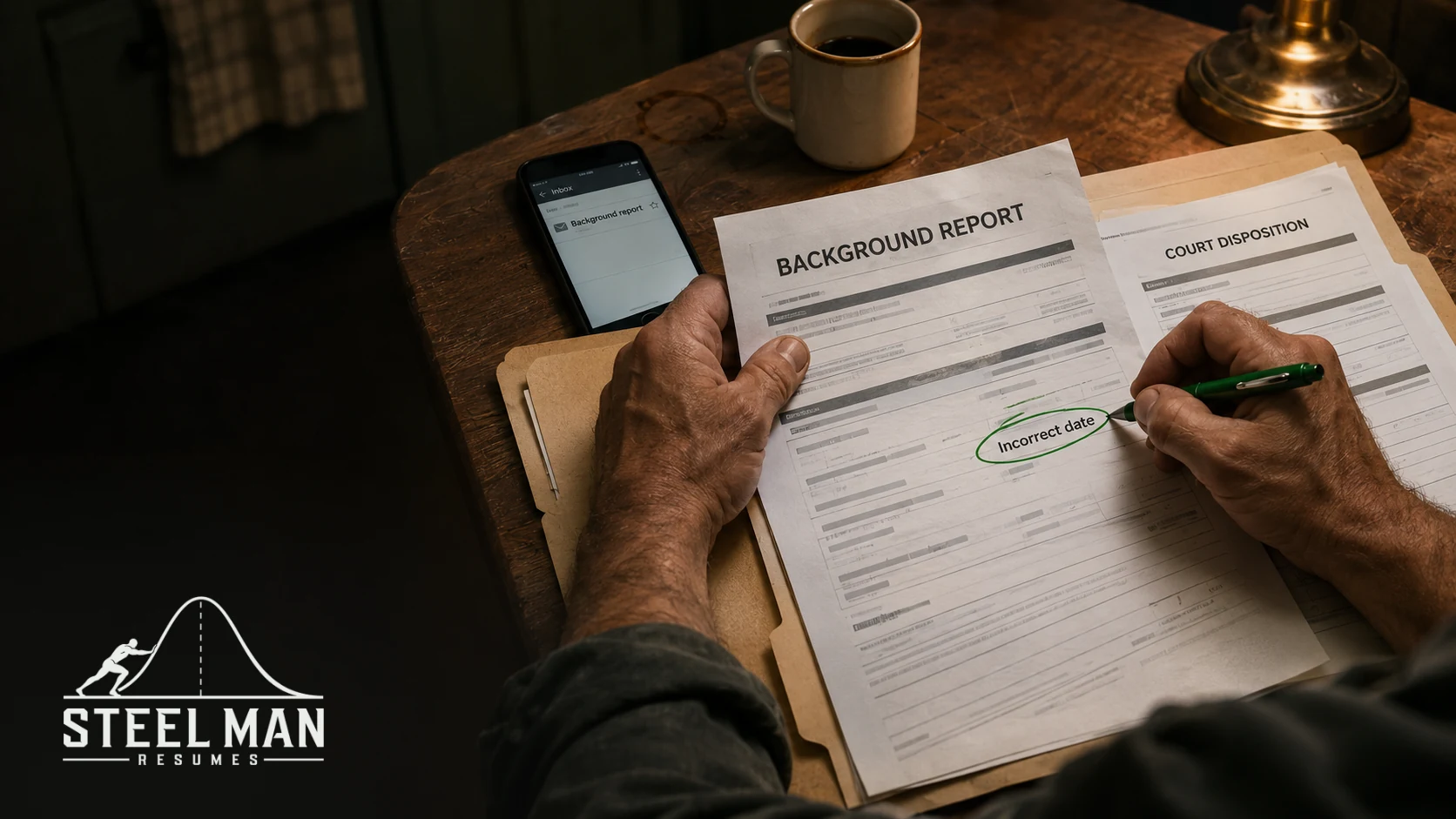
If you saw the news this week, you probably read it as "employers can turn down anyone with a record now."
That's not what happened. But it's not nothing either, and you need to know the difference before your next application.
On October 29 the EEOC, the federal agency that enforces job discrimination law, voted to pull its 2012 guidance on how employers should use arrest and conviction records. It took effect immediately. Here's what that changes, what it leaves alone, and where you stand.
01
What changed and what didn't
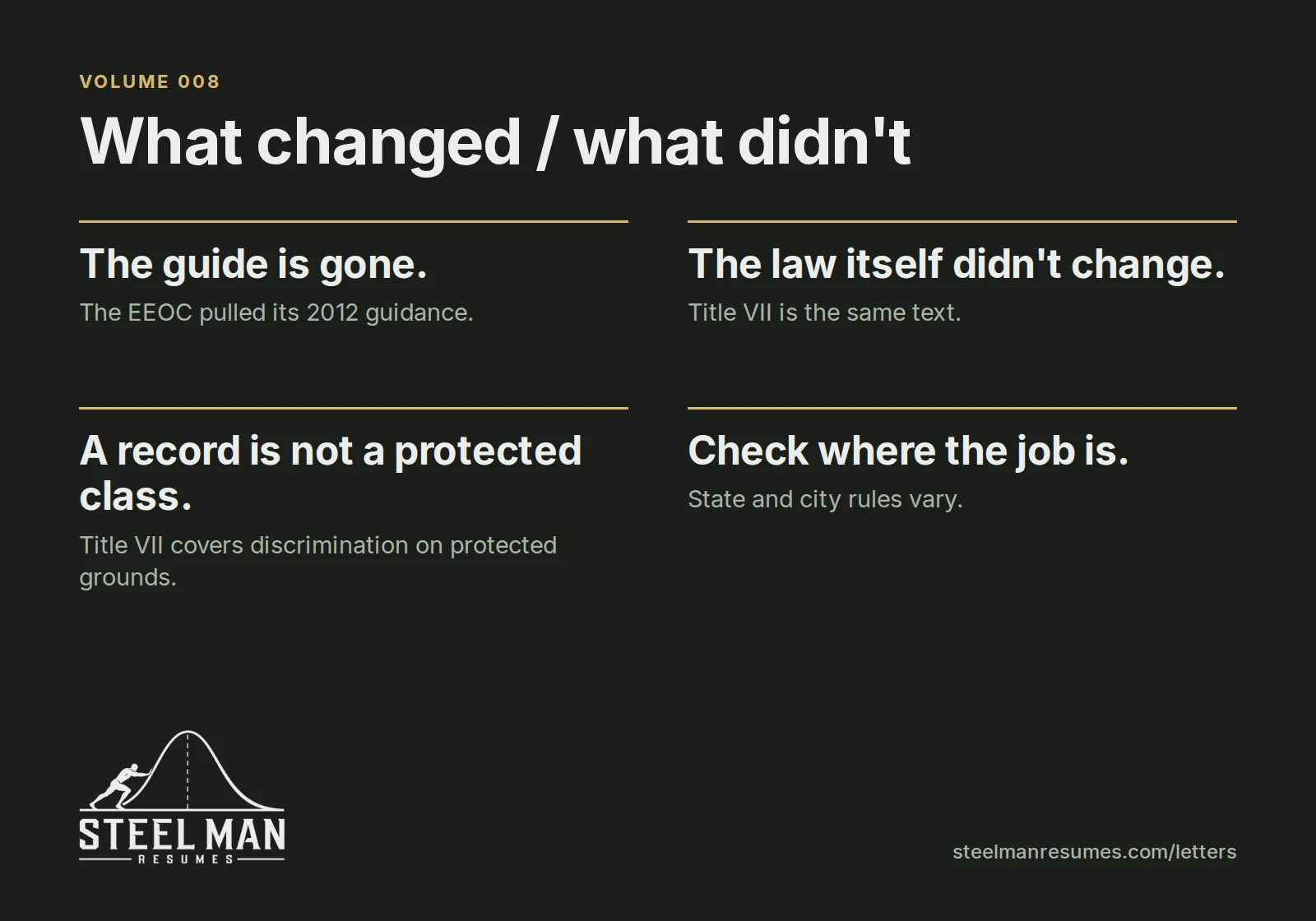
The guide is gone. The EEOC's own announcement says it voted to rescind the Enforcement Guidance on the Consideration of Arrest and Conviction Records that it approved in 2012.
The announcement also says the rescission "does not restore policy statements superseded by the 2012 Guidance, nor does it require employers to abandon any lawful practices they may have adopted in response to it." So an employer who already runs a fair process doesn't have to stop.
The law itself didn't change. The statute behind that guide, Title VII, still says an employment practice that causes a disparate impact on race, color, religion, sex or national origin is unlawful unless the employer shows it's job related and consistent with business necessity. And the EEOC says Title VII still prohibits requirements that are proxies for intentional discrimination.
Here's the part nobody tells you. Title VII never listed a criminal record as something protected. The guide was about how a blanket record screen can land harder on one group than another. With the guide gone, an employer has one less federal document telling it where the line is, and you have one less federal document to point to.
What I can't tell you is how hard the EEOC will go after an employer now. The announcement doesn't say, and I'm not going to guess.
What that means in plain words: the thing that protects you most right now is the state or city where the job is. And that varies a lot.
02
If they pull your record
This part works the same everywhere in the country. If an employer uses a background check company, the Fair Credit Reporting Act says that before they turn you down because of the report, they have to hand you two things: a copy of the report, and a written summary of your rights.
- Ask for the report and the rights summary before they decide. If you got a notice, the date on your notice is the one that counts. Federal law doesn't set a number of days to answer, so don't sit on it.
- Read it and mark what's wrong. A wrong date, a case that isn't yours, a charge that was dismissed or sealed and still shows. The company that made the report has to look into a dispute within 30 days of getting it.
- Check your state's test, below.
- Write down your deadline, so you don't lose a complaint you could have filed.
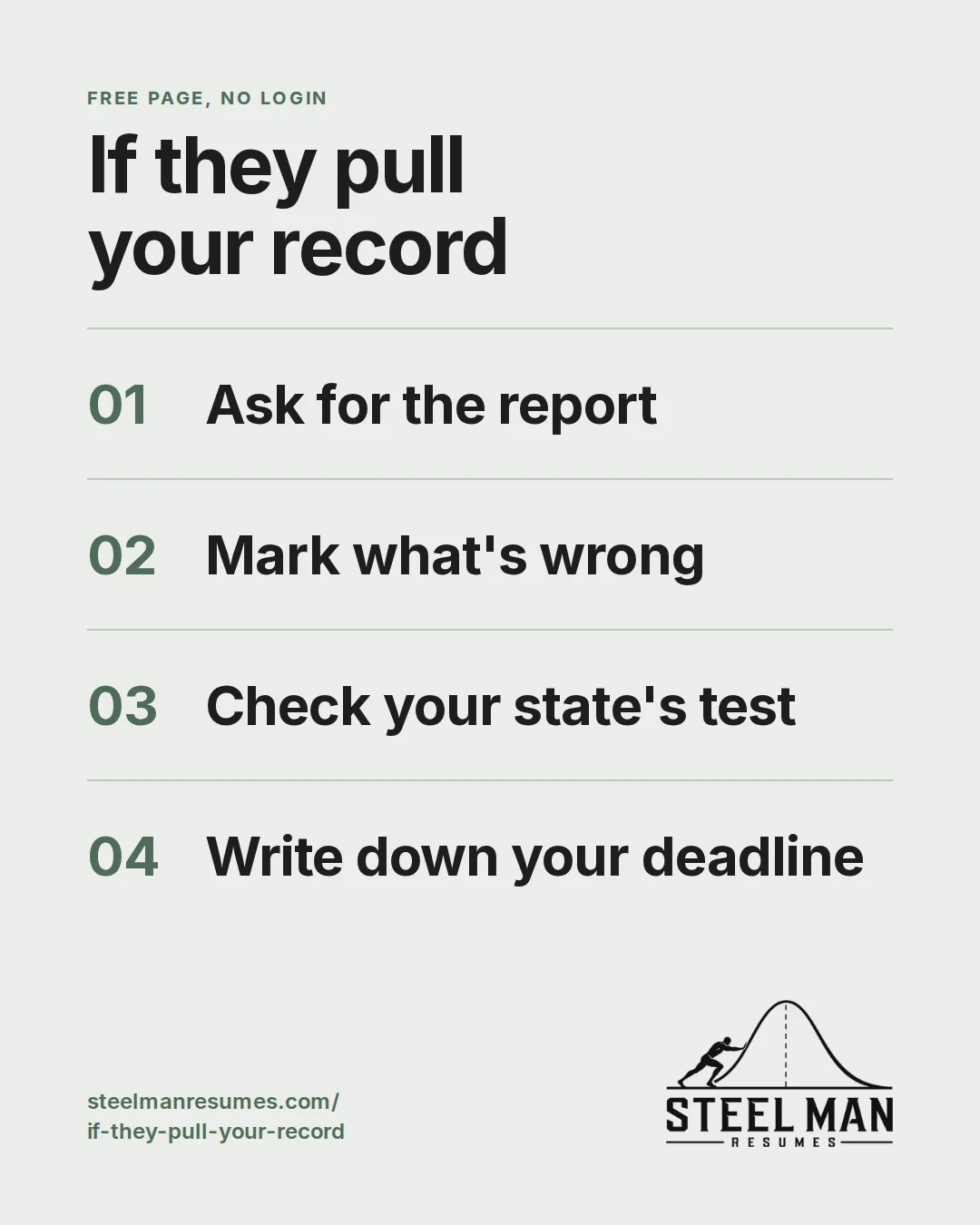
I put all four steps, the letters, and a calendar reminder on one page you don't need an account for: steelmanresumes.com/if-they-pull-your-record
Open the free pageFour steps, three letters, a calendar reminder. No login. Nothing you type leaves your device.
03
How your state changes it
Same federal law, different state rules.
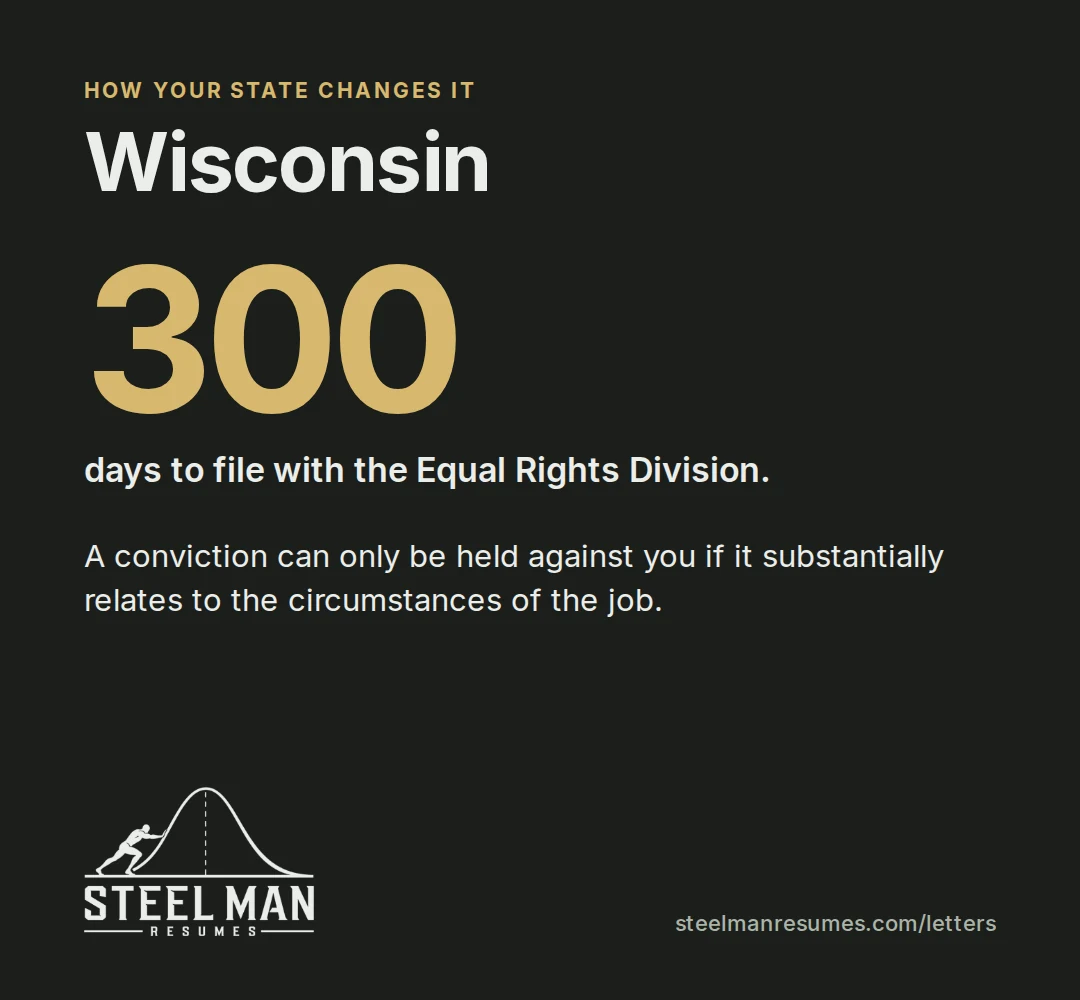
Wisconsin
A conviction can only be held against you if it substantially relates to the circumstances of the job. A theft conviction can be tied to a cashier job. A drunk driving offense can be tied to driving a truck. The state labor department says an employer cannot make a rule that no one with a record will be hired. If you think they broke it, you have 300 days to file with the state's Equal Rights Division.
Montana
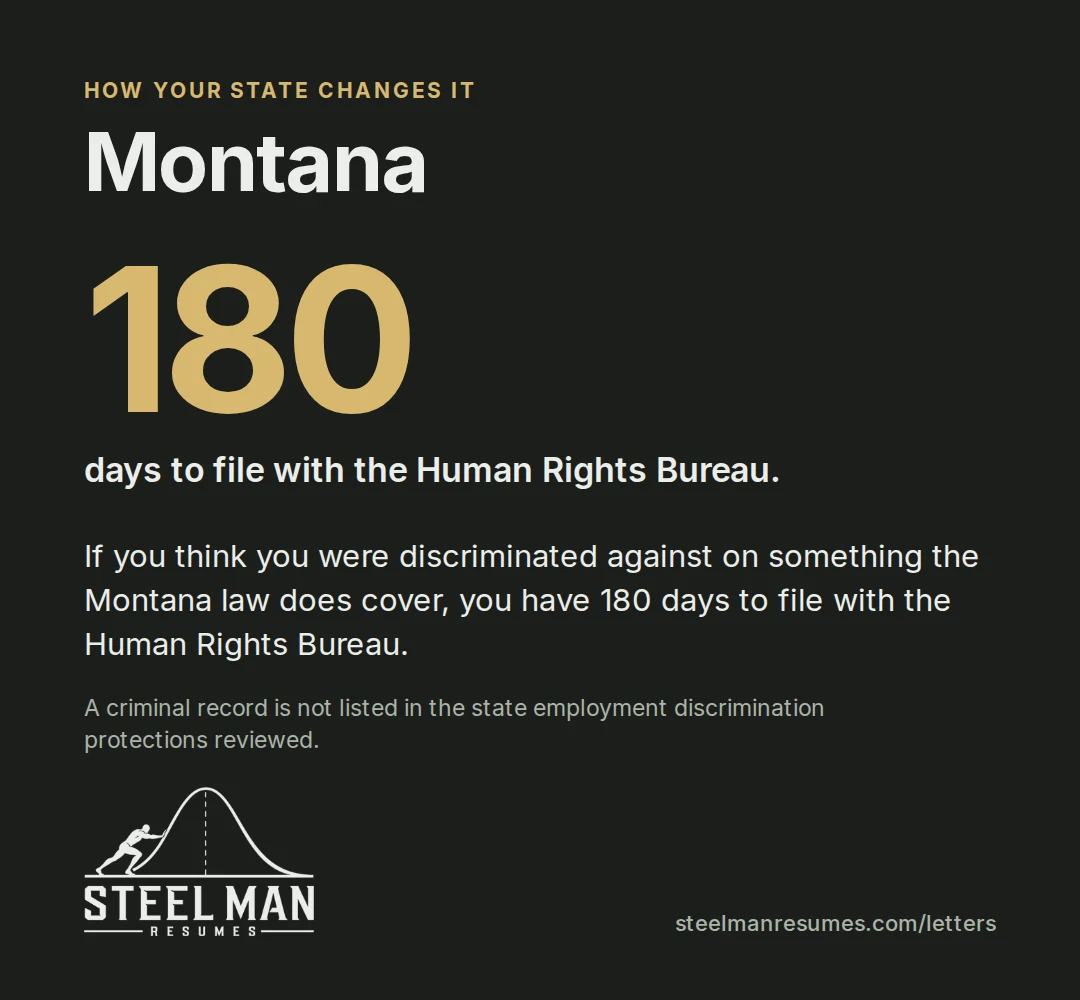
I've spent the last few weeks mapping what's out there in Montana, and this is the thing that stood out: the rules are thinner here. In what we read, the state anti-discrimination law doesn't list a criminal record, and we didn't find a Montana law that bans the question on an application. State hiring managers are even told to put a short statement about background checks in the posting. Licensing is different. A conviction can't be an automatic bar to a license, and finishing probation or parole counts as evidence you've been rehabilitated. If you think you were discriminated against on something the Montana law does cover, you have 180 days to file with the Human Rights Bureau. Misdemeanors can be expunged once in a lifetime.
New York City
Rules that took effect October 30 say a job ad can encourage people with records to apply. Before a conditional offer, an employer can't ask about your record or mention that background checks will be run.
Washington
Employers with 15 or more employees can't ask about your record until after they've decided you're otherwise qualified, and they can't advertise in a way that shuts out people with records. Employers with fewer than 15 employees are covered starting January 1, 2027.
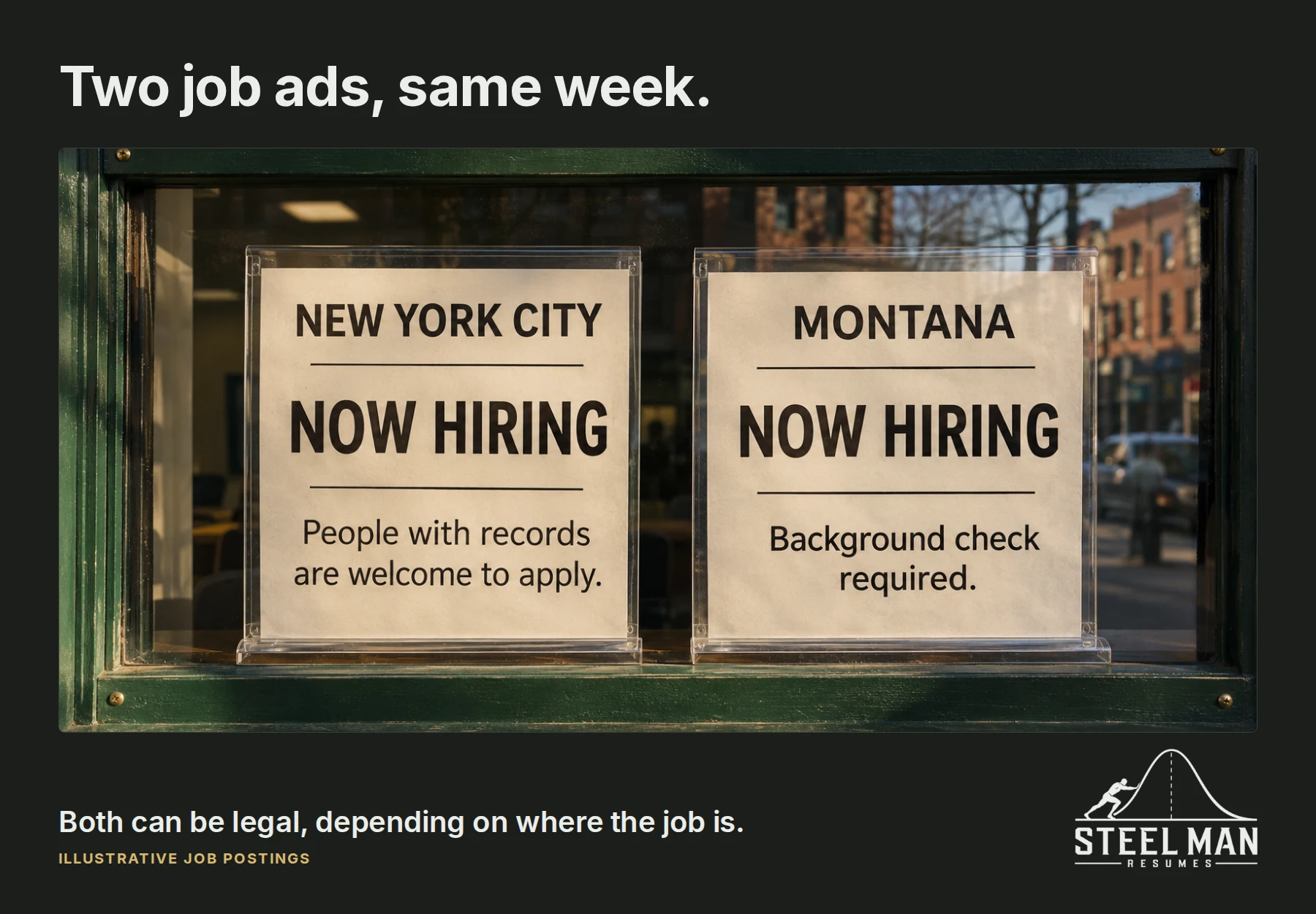
Two job ads, same week. One says people with records are welcome to apply. One says a background check is required. Both can be legal, depending on where the job is.
Every other state has its own page: steelmanresumes.com/jobs-for-felons
04
If you're helping someone
If you work with people coming home, one thing to do this week: ask them whether they have a copy of the last background report an employer used on them, and whether they know the name of the company that ran it. Getting that name is the first step to fixing a wrong entry.
Reply to this email if your state is missing from the list, or if something I wrote doesn't match what you've seen.
Troy
Get the next one
One letter a week from Troy. Something you can use in your job search. Free, with a link to unsubscribe in every issue.
Sources
Checked November 15, 2026.
- EEOC press release, October 29, 2026
- Title VII, 42 U.S.C. 2000e-2(k), U.S. Code 2023 edition
- Fair Credit Reporting Act, 15 U.S.C. 1681b(b)(3), U.S. Code 2023 edition
- Fair Credit Reporting Act, 15 U.S.C. 1681i, U.S. Code 2023 edition
- Wisconsin Statutes s. 111.335
- Wisconsin Department of Workforce Development, arrest and conviction record
- Montana Code 49-2-303, 49-2-501, 37-1-203, 37-1-205, 46-18-1104
- Montana Human Rights Bureau
- Montana HR Recruitment and Hiring Guidelines, June 2026
- NYC Commission on Human Rights, adopted rule, effective October 30, 2026
- Washington RCW 49.94