Troy's letter / Volume 007 / November 2026
Rejected an hour after you applied? Software probably read it first.
Most big employers let software take the first pass at your application, and more of that software runs on AI every year. Here's what it screens out, what a federal court is looking at right now, how your state changes it, and a free checker that shows where your applications are stalling.
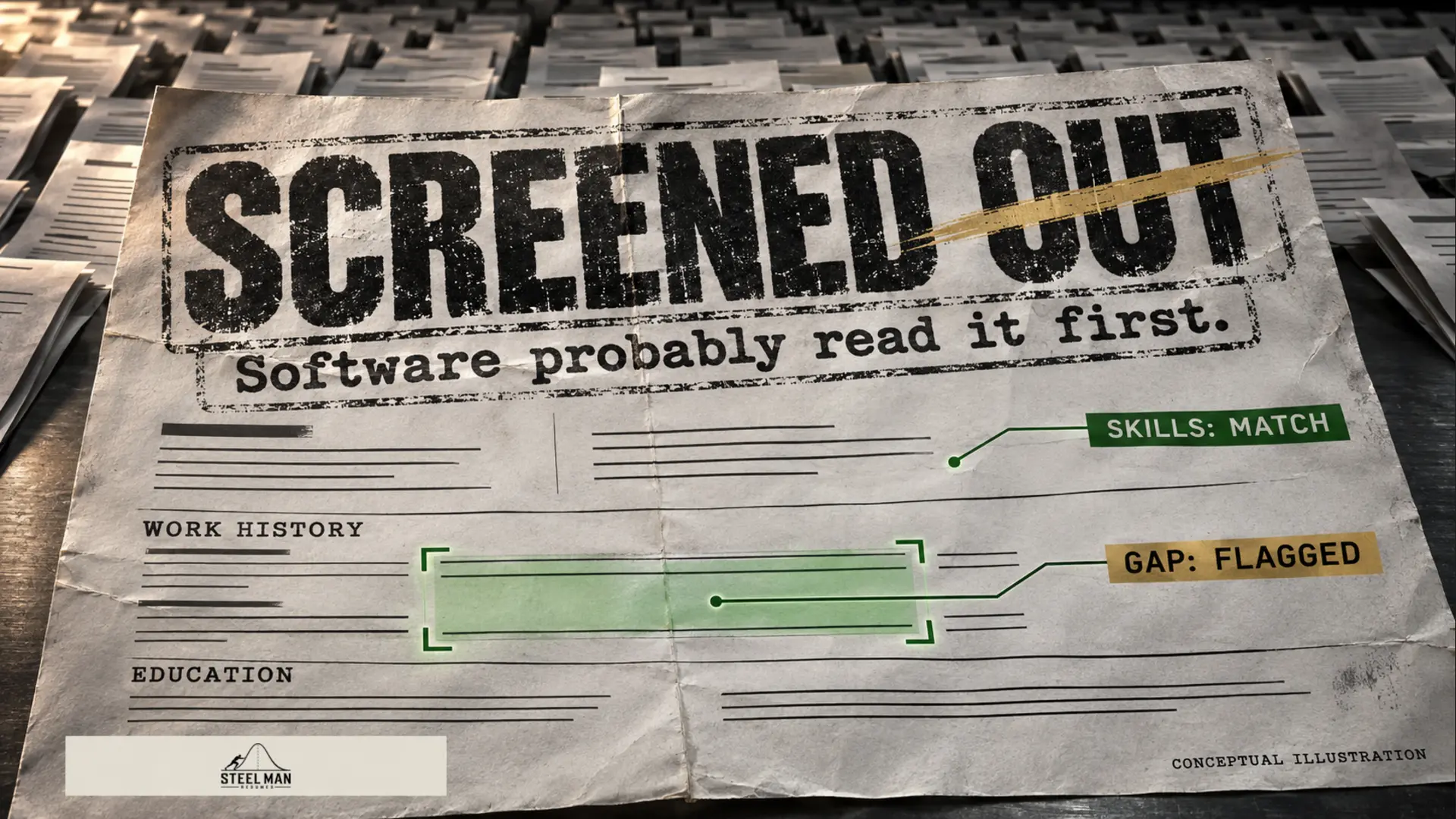
You put in an application at night. You wake up to an email.
That probably wasn't a person. Software read it first, and it might have tossed you over one box.
You're not being paranoid. The employers say so themselves. Here's what's going on, what a federal judge is looking at right now, and how to get your application in front of somebody who can actually say yes.
01
What the numbers show
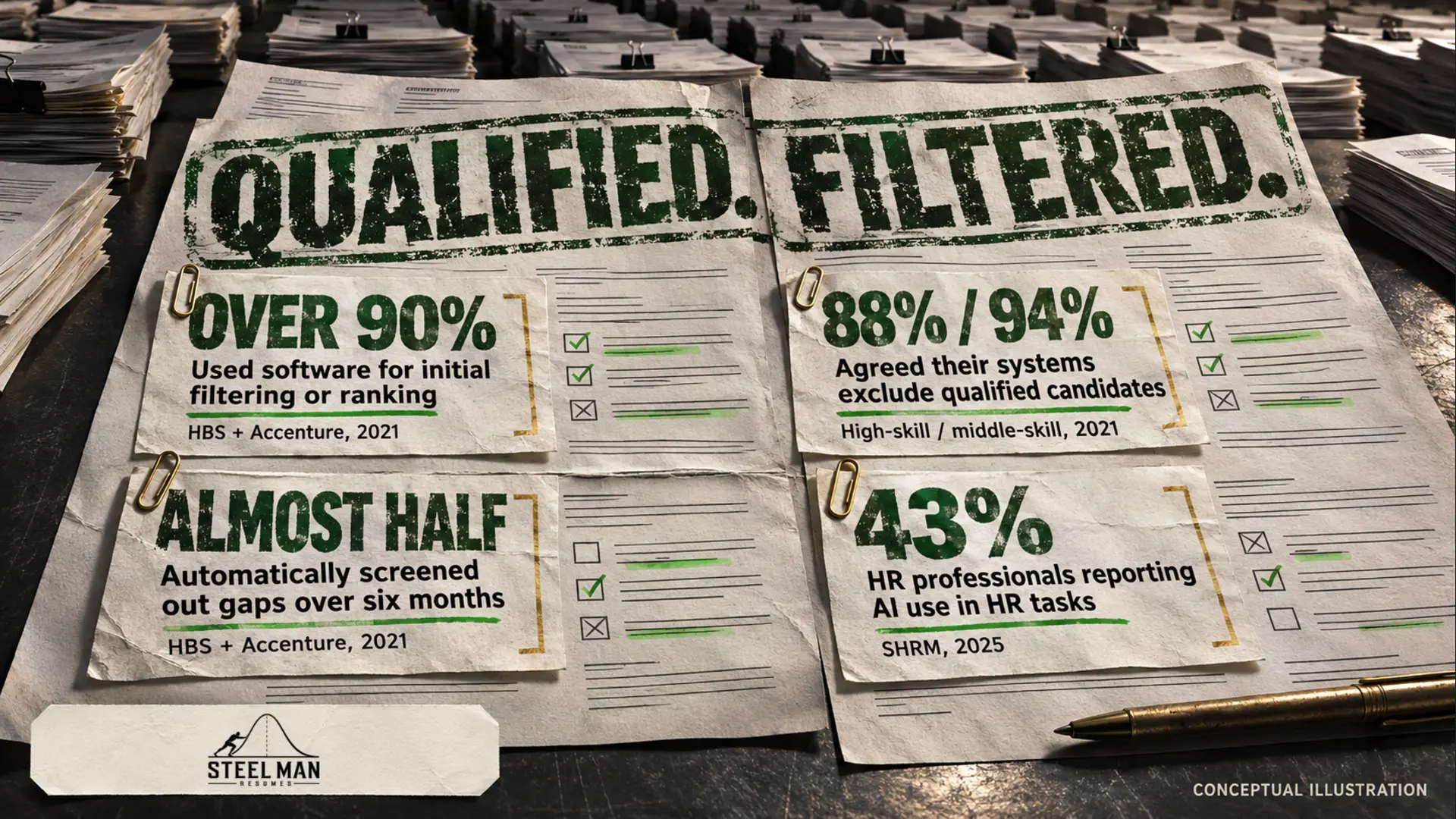
Over 90%. Harvard Business School and Accenture surveyed more than 2,250 executives in the US, UK and Germany. Over 90% said their recruiting software does the first filter or ranking of candidates. That was 2021, before every company started bolting AI onto it.
88% of those employers agreed that their own systems screen out qualified people because they don't match the exact criteria in the job description. For middle-skill jobs (the ones that need a certificate or some training but not a four-year degree) it was 94%.
Almost half of the companies threw out any resume with a work gap longer than six months. Automatically. A recruiter never sees it. The report put it plainly: “Such filters obviously cannot infer what caused such a gap to occur.” It also names a criminal conviction as a common thing these filters are set to screen out.
43% of HR professionals said they used AI in HR work in SHRM's 2025 survey. A year earlier it was 26%.
Then there's the court case.
Derek Mobley says that since 2017 he applied to more than 100 jobs at companies that use Workday's screening tools, and got turned down for every one. He didn't sue the employers. He sued Workday, the software company. In May 2025 a federal judge in California let his age claim go forward for applicants 40 and over, and in June 2026 the same judge kept most of the case alive, including new claims under California law. The four people who joined him each say they got at least one automated rejection for a job they were qualified for.
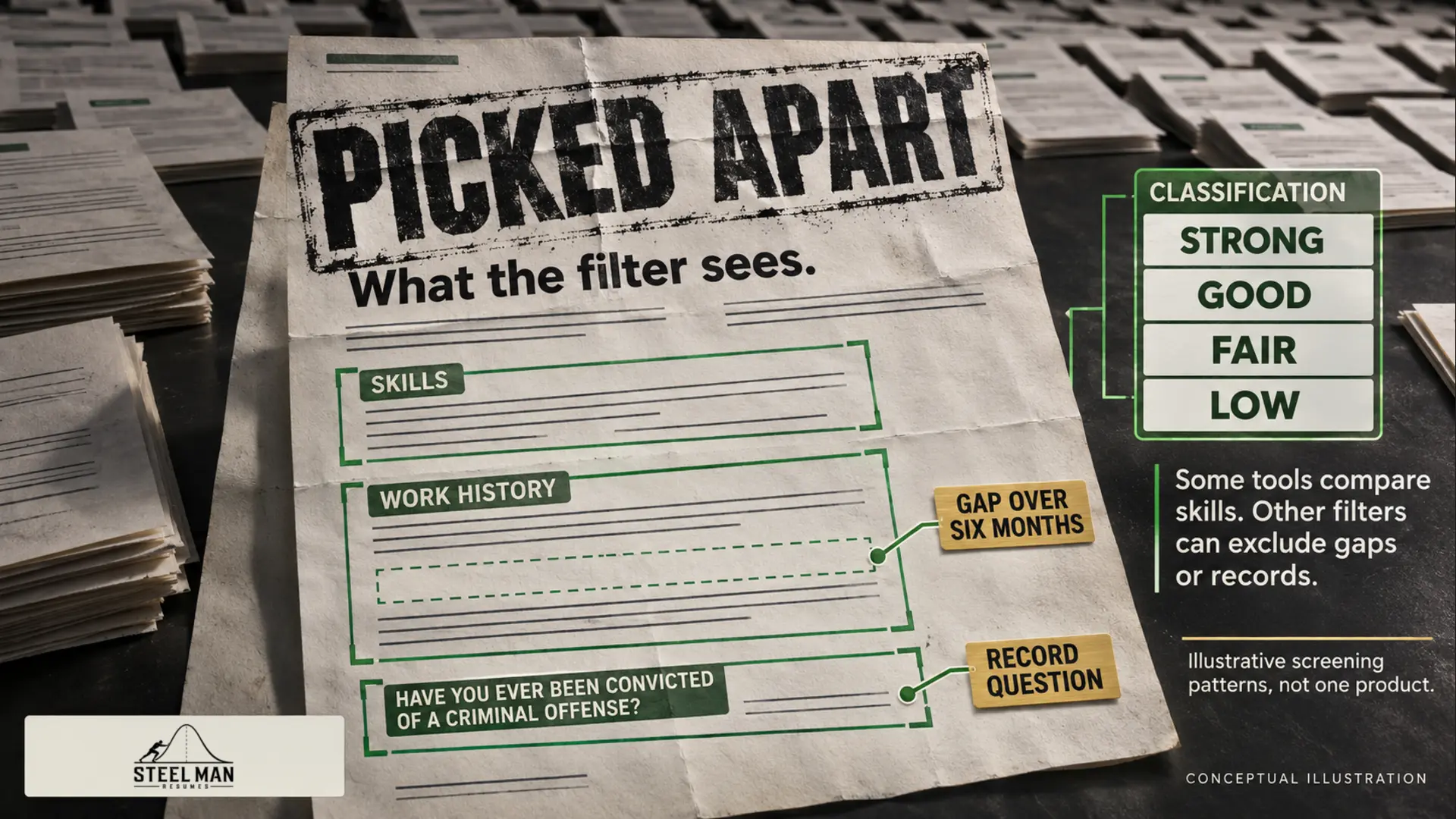
The court's May order describes one of Workday's tools. It pulls the skills out of the job posting and out of your application and rates the match “strong,” “good,” “fair” or “low.” That's the kind of thing reading your resume before a person does.
Nobody has proven Workday discriminated against anyone. That's not decided. A hearing on whether it goes forward as a class action is set for March 2027. And the case is about age, race and disability, not records. But it's the first big look inside how these tools sort people, and if you have a record or a gap, you're exactly who a filter like this is set up to miss, and it can happen before anybody reads your name.
02
How to get past the filter
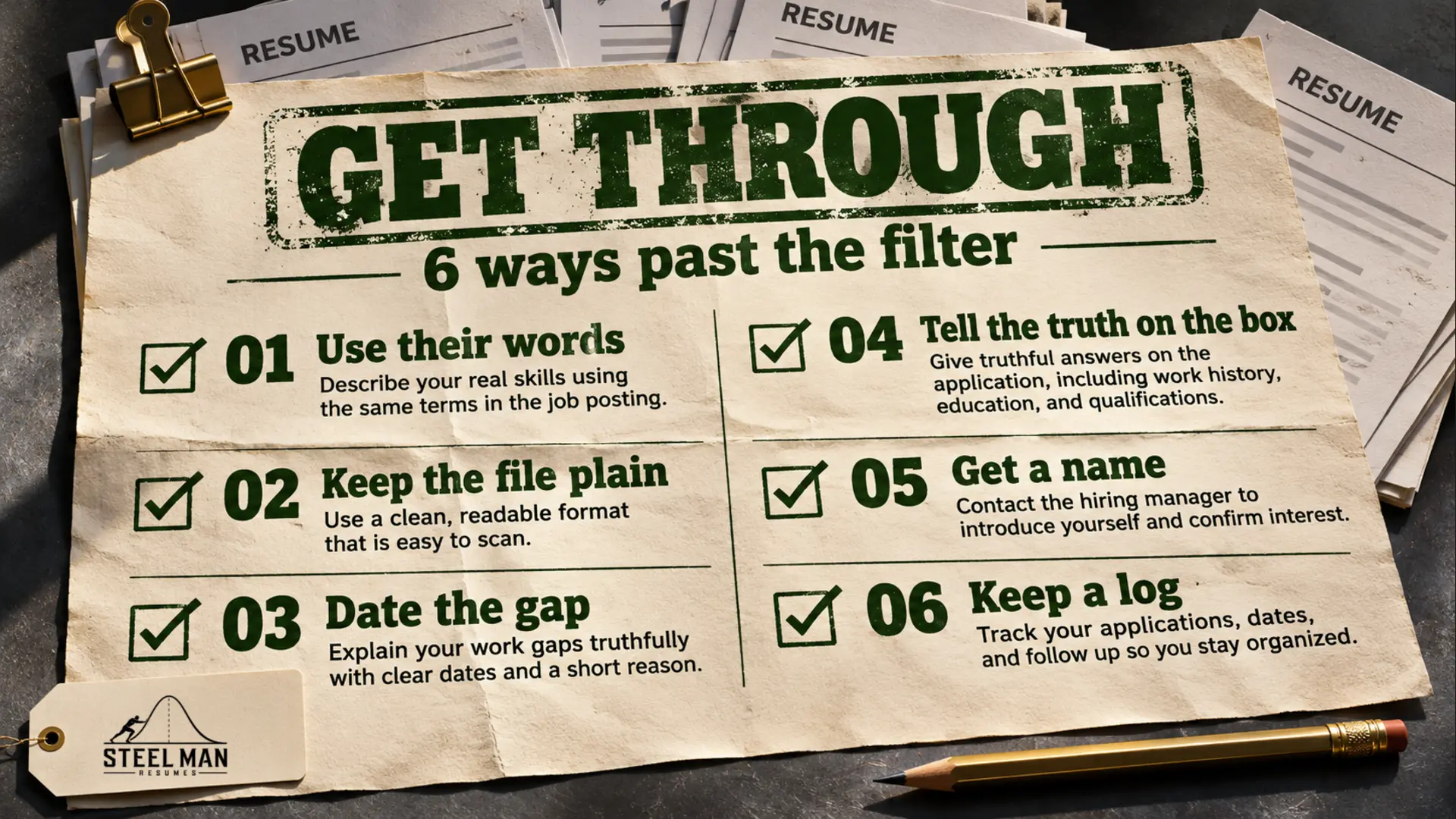
Use their words for things you've really done.
The tool in the Workday case compares the skills in the posting to the skills in your application. So read the posting and circle the skills. If you've done it, say it the way they said it. If they wrote “forklift,” don't write “material handling equipment.” Never add a skill you can't talk about in an interview, because a person is going to ask.
Keep the file plain.
One column. Normal headings like Work History and Skills. No tables, no text boxes, no picture of your name. Send the file type they ask for. A fancy template looks good on your screen and can come out scrambled on theirs.
Put dates on the gap and say what was in it.
The software can't tell why you were gone, so give it something to read. Training, a program, a certificate, work you did inside, caring for family. You decide how much of it goes on the page. Our gap guide has the exact wording.
Tell the truth on the record question, and know when they can't ask.
A lot of states and cities don't let employers ask about a record on the application. If yours does and they ask, don't lie. A lie that turns up on the background check can cost you the job when the record itself might not have. Our fair-chance guide has the rules by state.
Get a name.
Apply online, then go find a person. Call the front desk and ask who's hiring for the job. Walk in if it's a local shop. If you know anybody who works there, ask them to hand your name to the manager. The filter only decides what a recruiter sees. It can't stop a manager from asking for you.
Keep a log.
Write down the job, the day and time you applied, and when the no came back. If you were qualified and the rejection showed up at 2 in the morning, write that down too. A log shows you which places to stop wasting applications on and which ones to call instead. It's also what you'll want if you ever think something wasn't right.
More: How to write a resume with a felony.
03
How your state changes it
Same software, different rules, depending on where the job is.
New York City
If an employer uses an automated tool to screen you, the city's law says it has to tell you at least 10 business days before it's used, tell you what qualifications the tool looks at, and let you ask for a different process or an accommodation. The employer also has to post a summary of a bias audit done within the last year before using it. If you're applying in the city, look for that notice, and use it.
California
Since October 1, 2025, California's civil rights rules say plainly that automated systems used in hiring fall under the same discrimination law as everything else, and employers have to keep that data with your application records for four years. Separately, the Fair Chance Act generally bars employers with five or more employees from asking about conviction history before they make a job offer. One thing that got cut: an early draft would have made an employer tell you about the AI tool if it used one to pull a job offer over your record. That part came out before the rules passed.
Illinois
Since January 1, 2026, Illinois law makes it a civil rights violation for an employer to use AI in hiring in a way that has the effect of discriminating, or to use zip codes as a stand-in for things like race. The law also says employers have to tell employees when they use AI for those decisions. It doesn't spell out job applicants, and the state agency is supposed to write the rules for that notice.
Everywhere else
Federal discrimination law covers a hiring decision whether a person made it or software did. That's what the Workday case is being fought under. In April 2025 an executive order told federal agencies to make “disparate impact” cases a low priority. Those are the cases that say a rule hurts a group even if nobody meant it to, which is what most software cases are. So for now, state rules and lawsuits like Mobley's are carrying more of the weight.
04 / Free tool
Where are my applications stalling?
Nine quick questions. Nothing you pick here leaves this page.
0 of 9 answered
My application log (copy or print)
Job | Company | Day and time applied | When the no came back | Was I qualified? | Did I reach a person?
---------------------------------------------------------------------------------------------------------
   |         |                      |                       |                  |
   |         |                      |                       |                  |
   |         |                      |                       |                  |
If you help people find work, sit down and do the checker with them. Seeing where the no's are coming from will tell you more than another rewrite.
If you hire, and you use one of these tools, try this. Apply to your own job with a strong resume that has a seven-month gap in it, and see what comes back. If you don't like the answer, reply to this letter. Setting these tools up so they stop throwing out people you'd actually hire is work I do through The Midnight Garden.
Troy
Get the next one
One letter a week from Troy. Something you can use in your job search. Free, with a link to unsubscribe in every issue.
Sources
Checked November 8, 2026.
- Hidden Workers: Untapped Talent, Fuller, Raman, Sage-Gavin and Hines, Harvard Business School and Accenture, September 2021 (updated October 4, 2021), pages 5, 22 and 25.
- SHRM 2025 Talent Trends, survey of 2,040 HR professionals, February 3 to 12, 2025.
- Mobley v. Workday, Inc., No. 3:23-cv-00770-RFL (N.D. Cal.): order granting preliminary collective certification, May 16, 2025; order on motion to dismiss, June 22, 2026; order changing the schedule, July 13, 2026. Court documents on GovInfo and the July 13, 2026 order.
- NYC Automated Employment Decision Tools, Local Law 144 of 2021, rules effective July 5, 2023.
- California Civil Rights Council, automated-decision systems regulations, effective October 1, 2025, and Final Statement of Reasons.
- California Civil Rights Department, Fair Chance Act.
- Illinois Public Act 103-0804 (HB 3773), amending the Illinois Human Rights Act, Section 2-102(L), effective January 1, 2026.
- Executive Order 14281, April 23, 2025.