Use AI to get hired.
Know where it lies.
Hiring is slow and everybody is using AI to apply. There's no reason to do it the hard way. There is a way to do it wrong.
The September jobs report came out October 2 and it was bad. The country added 29,000 jobs. Unemployment went up to 4.2 percent, which is 7.1 million people looking. July got revised down to a loss.
When there aren't many jobs, the pile of resumes on each one gets taller, and whoever cuts that pile cuts it fast. Sometimes that's a person and sometimes it's software.
So here's what I think. There's no reason to struggle through the old way of making a resume. AI has mastered language. It can take what you did and say it clean, and I want you using it.
I also want you watching it. It makes things up and it flatters you, and it has biases you can't see from your side of the screen. This one is how to use it, and how to watch out.
The September jobs report
- Released
- October 2, 2026, by the Bureau of Labor Statistics.
- Jobs added
- 29,000. The BLS says employment "changed little."
- Unemployment
- 4.2 percent, 7.1 million people.
- Revisions
- July went from +21,000 to -10,000. August went from +162,000 to +133,000.
The limit: one month of numbers gets revised. Read it as a signal, not a verdict.
A new Forge and Refinery
I'm finishing a new version of the Forge and the Refinery. It isn't out yet and I won't give you a date until it is.
What I've been testing for above everything else is whether it sticks to what you told it. So far, with made-up people and not real ones:
It keeps your employers and your dates exactly the way you gave them.
When a job posting asks for a forklift ticket and you never said you had one, it doesn't write one in.
When it can't back a line up with something you told it, it flags the line instead of smoothing it over. In one practice interview it held back a suggested answer because nothing the person said supported it.
It isn't perfect. A couple of the flags it raised were on lines that were fine. I'd rather it flag too much than too little.
Use AI on your resume without losing the truth.
Works with any AI. Nothing you type on this page leaves it.
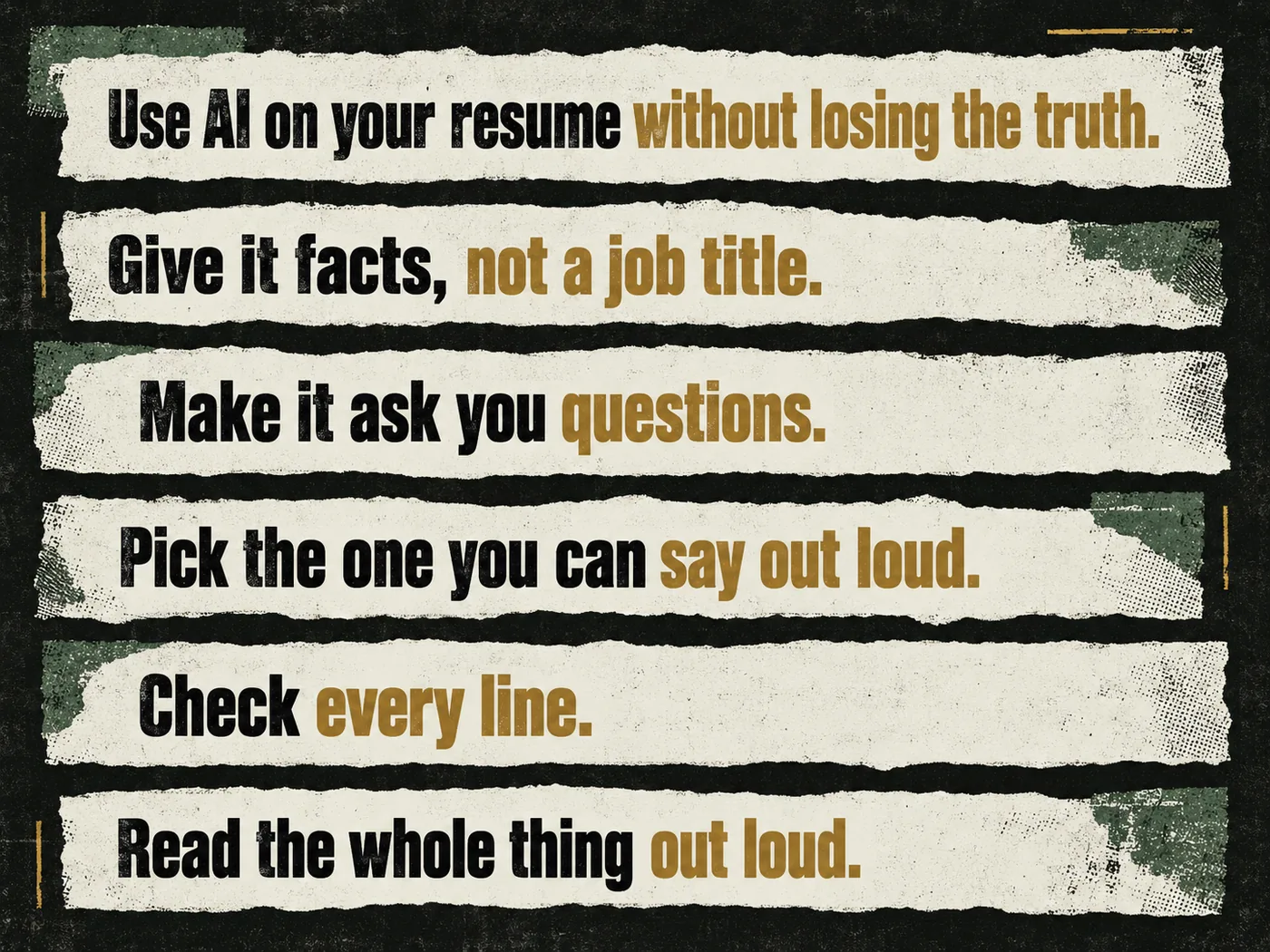
Give it facts, not a job title.
Paste in your real work history and tell it to use only that. Leave out your Social Security number and any case numbers. Some free AI tools can learn from what you type, so check the settings first.
Make it ask you questions.
The best lines come from it digging, not from it guessing. Answer the questions. Short and true beats big and fuzzy.
Pick the one you can say out loud.
Take the three versions of a line and choose the one that sounds like you telling it to a person.
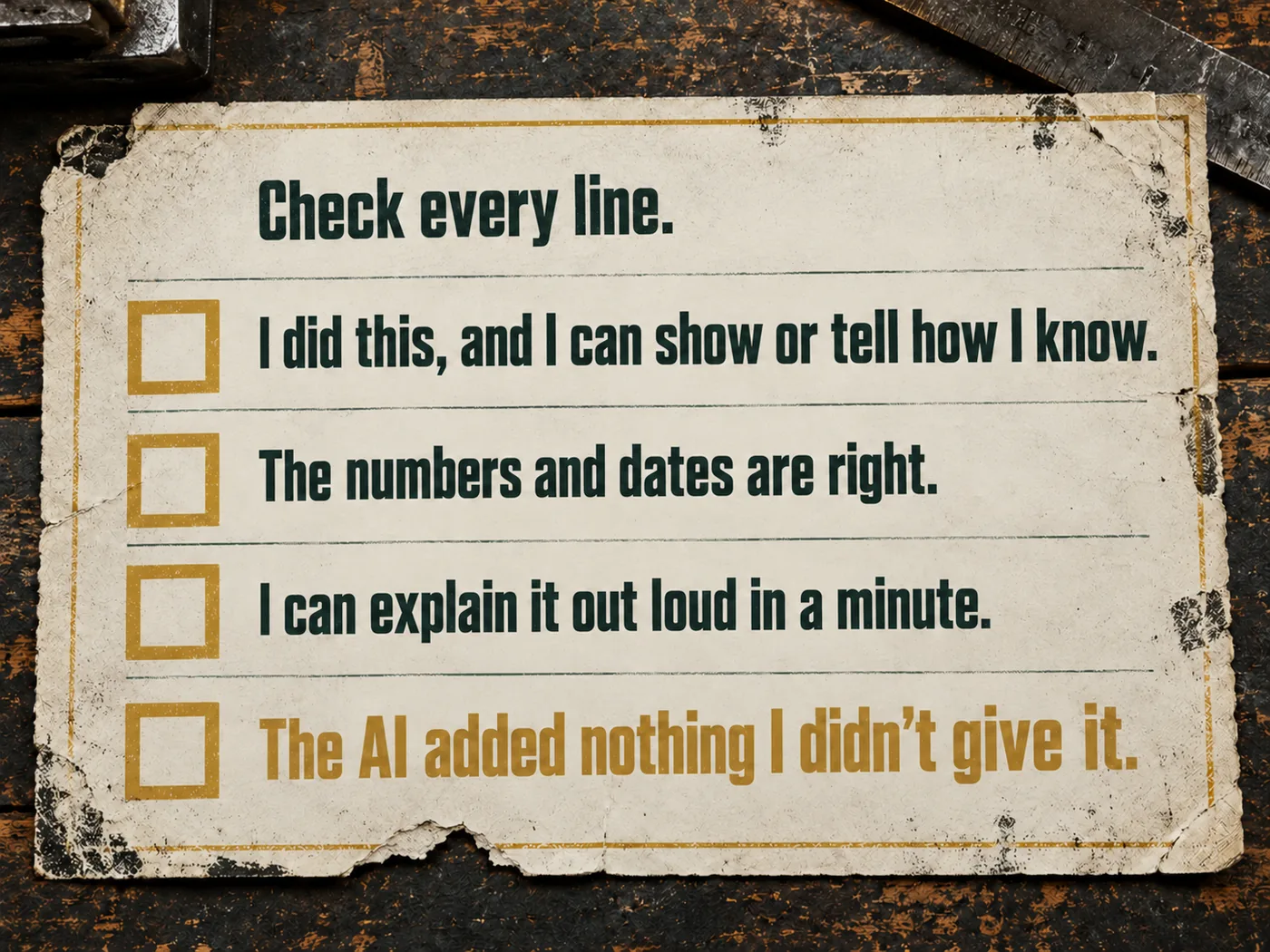
Check every line.
AI fills blanks with whatever sounds right. Check each date and number against what you know. Paste one line below so it's in front of you, then run the four checks.
Read the whole thing out loud.
Where you stumble, it's either wrong or it isn't yours.
Two studies, and what they do and don't tell you.
Names
University of Washington researchers took more than 550 real resumes and varied 120 first names across them, white-associated and Black-associated, men's and women's. Three AI models ranked the resumes against more than 500 real job listings. The white-associated names came out ahead about 85 percent of the time. The Black-associated names came out ahead about 9 percent of the time.
The limit: that was a lab test of the kind of model that can sit inside a hiring tool. It doesn't tell you what any one employer's software does.
AI likes AI
A 2025 study by Jiannan Xu, Gujie Li and Jane Yi Jiang had AI models choose between resumes with the same qualifications. Some were written by people and some by AI. The models kept picking the AI-written ones, most of all when the writer was the same model doing the judging. In their simulated hiring runs, applicants who used the same AI as the screener were 23 to 60 percent more likely to be shortlisted.
The limit: it's a simulation, and the exact numbers changed between versions of the paper, so I'm not quoting a single percentage for the preference itself.
What I'd do about it.
You can't fix the first one from your side, and you shouldn't hide who you are to try. Put your effort where a person is looking. Get your resume in front of someone who can vouch for you, because a person who knows you isn't running a name score.
On the second one, using AI isn't cheating. It may even be helping you. But a resume that sounds like every other AI resume is one nobody remembers, so keep the details only you have. The real numbers, and the real name of the machine.
If it gets something wrong when you try this, I want to know. Reply to this letter and tell me.
Troy
Get the next one
Twice a week from Troy. What I'm building, what broke, what I learned, and one thing you can use. Free. Unsubscribe in one click.